The Battle
Rivalist is a 1 vs 1 civilization-building battle. Two players lead rival civilizations and race to build the more powerful city. The game plays over three Ages — each with its own deck. Age I is the gentlest; Age III is the most treacherous.
Every turn you take a card from a shared pyramid and either build it, discard it for coins, or sacrifice it to construct one of your Wonders. You win by overwhelming your rival on one of three fronts.
Three Paths to Victory
There are three ways to win. Two end the game instantly.
Military Supremacy
Push the Conflict Pawn all the way to your opponent's capital. The game ends the instant it arrives.
Scientific Supremacy
Collect 6 different scientific symbols across your green cards and progress tokens. The game ends immediately.
Civilian Victory (VP)
If no supremacy is claimed by the end of Age III, the player with the most victory points wins.
Starting Out
The board, decks, and tokens are all dealt out for you — this is an online battle, so there's no physical setup to worry about. Two things are worth knowing before you begin:
- Each player begins with 7 coins in their treasury. Coins pay for cards, for trading, and ultimately convert into VP at the end of the game (1 VP per 3 coins).
- Before the first card is played, you and your opponent draft 4 Wonders each from a pool of 12. Wonders are powerful one-time effects that can swing an entire game.
The Wonder Draft
Twelve Wonders are shuffled and laid out four at a time. Players take turns claiming Wonders in a snake order so that neither player gets every first pick. By the end of the draft each player owns exactly 4 Wonders.
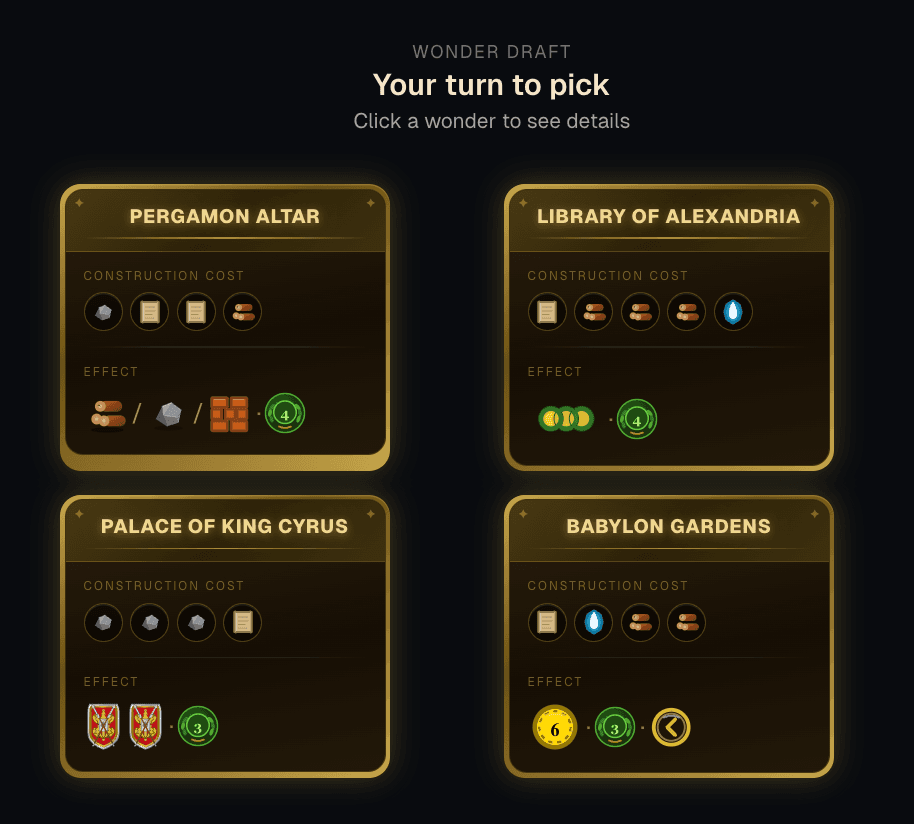
- 4 Wonders are revealed face-up between the players.
- Player 1 picks 1 · Player 2 picks 2 · Player 1 takes the last.
- 4 more Wonders are revealed — Player 2 picks first this time.
- Repeat the snake order until each player has 4 Wonders.
The Board
The board has three regions to know: the Military Track along the top, the Progress Tokens in the middle, and the Card Pyramid below. Everything you do in a turn touches one of them.
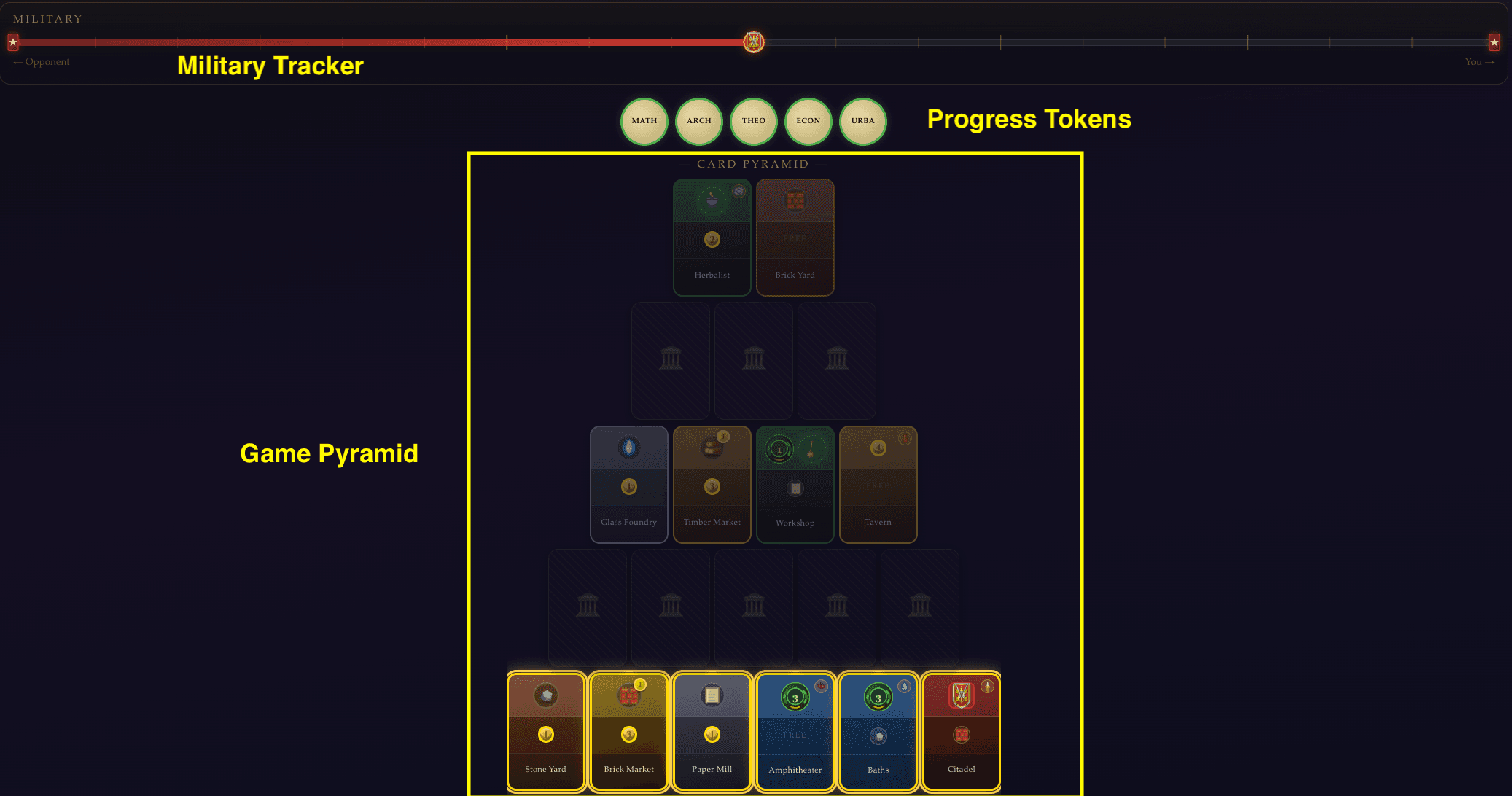
Military Track
A horizontal track with the Conflict Pawn sitting on it. Every shield printed on a red Building (or Wonder) you build pushes the pawn one space toward your opponent. A red card with 2 shields moves it 2 spaces. The pawn moves left or right depending on who built the card. Cross into a new zone on your opponent's side and you immediately loot 2 or 5 coins from them. Reach their capital and you win on the spot.
Progress Tokens
Five face-up tokens sit between the players. Each time you complete a pair of matching scientific symbols (from your green cards), you immediately claim any one Progress Token of your choice. They grant powerful permanent effects — discounts, coins, extra shields — and most are worth VP at the end.
Card Pyramid
20 cards laid in a pyramid shape, some face-up, some face-down. A card is accessible only if no other card is sitting on top of it. On your turn you may pick from any accessible card. When you remove one, any face-down card that becomes uncovered flips face-up — slowly revealing the deck as the Age progresses.
Your Turn
On your turn, take any one accessible card from the pyramid. You must then choose one of three actions:
Construct the Building
Pay the card's cost, then place it in your city. Its effect is active for the rest of the game.
Discard for Coins
Discard the card (pay nothing) and take 2 coins from the Bank, plus 1 additional coin for every yellow card already in your city.
Construct a Wonder
Pay the cost of one of your unbuilt Wonders, then slide the chosen card face-down under it. The card's effect is lost — the Wonder's effect triggers immediately.
Construction Costs
Resources are not spent when you build. A card that produces Wood keeps producing Wood forever — you can re-use it every turn.
Trading
If you don't produce a required resource, you may always buy it from the Bank. The price of a single missing unit is:
cost=2+(units your opponent produces of that resource)
- Only brown and grey cards in the opposing city are counted — yellow and Wonder production is ignored.
- There is no limit on purchases in a single turn.
- Some yellow Commercial Buildings fix the cost of certain resources at 1 coin, regardless of opponent production.
- The coins are paid to the Bank, not your opponent.
Card Anatomy
Every card has the same anatomy: a top band showing what it gives you, a name strip in the middle, and a cost at the bottom-left. Below the cost some cards also show a small chain-from icon — own the card with the matching symbol and this card builds for free.
Tap any example below to see exactly what it does.
Brown · Raw Materials
Produces a basic resource (Lumber, Brick, or Ore) every turn for the rest of the game. The icon at the top shows what it makes.
Grey · Manufactured Goods
Produces Paper or Diamond — the rare goods. Often costs a few coins to build, but the production is permanent.
Red · Military
Each shield at the top pushes the Conflict Pawn one space toward your opponent the instant the card is built.
Green · Scientific
Grants a scientific symbol. Pair two matching symbols to immediately claim a Progress token from the board.
Blue · Civilian
Worth victory points printed at the top — pure score. The small icon under the cost is a chain-from: if you own its source card, you build this one for free.
Yellow · Commercial
Coins, fixed-price trading, and sometimes VP. Look for the coin icons at the top to see what it grants on construction.
Purple · Unions
Only appear in Age III. Score victory points at game end based on cards in your or your opponent's city — the icon at the top tells you which.
Reading a card at a glance
- Top icons — what the card gives you when built (resources, shields, coins, science symbols, or VP).
- Cost (bottom-left) — resources and/or coins you must pay. Empty means free.
- Chain symbol (top-right of some cards) — a small icon this card grants, which can free-build a future card.
- Chain-from (under the cost) — if you already own the card showing this icon, ignore the cost and build for free. The card Horse Guard is a good example: own its chain source and it costs nothing.
End of an Age
An Age ends the moment the last card is drawn from the pyramid. The next Age is laid out immediately.
Who starts the next Age? The player with the weakermilitary — whoever's side the Conflict Pawn is sitting on — chooses. If the pawn is exactly on the center space, the player who took the final card of the old Age chooses.
Final Scoring
If no supremacy has been claimed by the end of Age III, add up each player's victory points. Highest score wins.
- Military VP:0, 2, 5, or 10 points based on the Conflict Pawn's final position on your side.
- Blue Civilian Buildings: VP printed on the card.
- Yellow Commercial Buildings: some award VP.
- Green Scientific Buildings: VP printed on the card.
- Purple Union Cards: scored on their individual conditions.
- Wonders: VP as printed on each constructed Wonder.
- Progress Tokens: VP per token (varies).
- Treasury: 1 VP per complete set of 3 coins.
The Progress Tokens
10 exist; five are dealt each game. Claim one each time you complete a scientific pair.
- Harvest
- This progress token gives you 6 coins. At the end of the game, you receive 4 VP.
- Construction
- This progress token allows you to take off two resources when building a Wonder
- Trade
- When your opponent purchases resources from the trading post during building, gain the coins paid directly into your treasury.
- Theory
- This progress token gives you an extra science symbol
- Blacksmith
- This progress token allows you to take off two resources when building a blue (civic) card
- Multiplication
- This progress token allows you to gain 3 VP per progress token you have at the end of the game (including this one).
- Ideaology
- This progress token allows you to gain 7 VP at the end of the game.
- War
- Every time you build a military card, this token adds 1 shield to the card. Does not apply to Wonders.
- Religion
- Each wonder you build in the future, will receive a re-turn unless the Wonder already has one.
- Sociology
- This progress token gives you 6 coins immediately. For every building you construct using a chain linking, you will receive 4 coins from the bank.
The Wonders
11 Wonders exist; each player drafts four and may build at most four over the course of the game. Only seven total Wonders are raised across both players — one is always left unbuilt.
- Babylon Gardens
- Gain 6 coins immediately. Also: Worth 3 Victory Points at end of game. Also: Take another turn immediately after this one
- Temple of Ares
- Destroy one of your opponent's Raw Material cards. Also: Grants 1 Shield (advances military track). Also: Worth 3 Victory Points at end of game
- Library of Alexandria
- Choose 1 Progress Token from the available tokens. Also: Worth 4 Victory Points at end of game
- Palace of King Cyrus
- Grants 2 Shields (advances military track). Also: Worth 3 Victory Points at end of game
- Pergamon Altar
- Produces one of: Lumber / Ore / Brick. Also: Worth 4 Victory Points at end of game
- Coliseum
- Destroy one of your opponent's Manufactured Goods cards. Also: Worth 3 Victory Points at end of game. Also: Grants 1 Shield (advances military track)
- The Red Fort
- Gain 12 coins immediately. Also: Take another turn immediately after this one
- Chinese Tower Ships
- Produces one of: Paper / Diamond. Also: Take another turn immediately after this one. Also: Worth 2 Victory Points at end of game
- The Alcantara Bridge
- Choose one non-science card from your opponent to steal and build for free. Also: Worth 3 Victory Points at end of game
- The Legion of Rome
- Destroy one of your opponent's Commercial Buildings cards. Also: Gain 5 coins immediately. Also: Worth 3 Victory Points at end of game
- Legends of Valhalla
- Gain 6 coins from your opponent. They will lose 6 coins. Also: Worth 3 Victory Points at end of game